
Spiral Curriculum
A spiral curriculum is a program design approach in which students revisit important learning priorities multiple times across courses, with increasing depth, complexity, and independence. Instead of introducing a skill, disposition, or character trait once, faculty intentionally create repeated opportunities for students to practice, reflect on, and demonstrate growth over time.
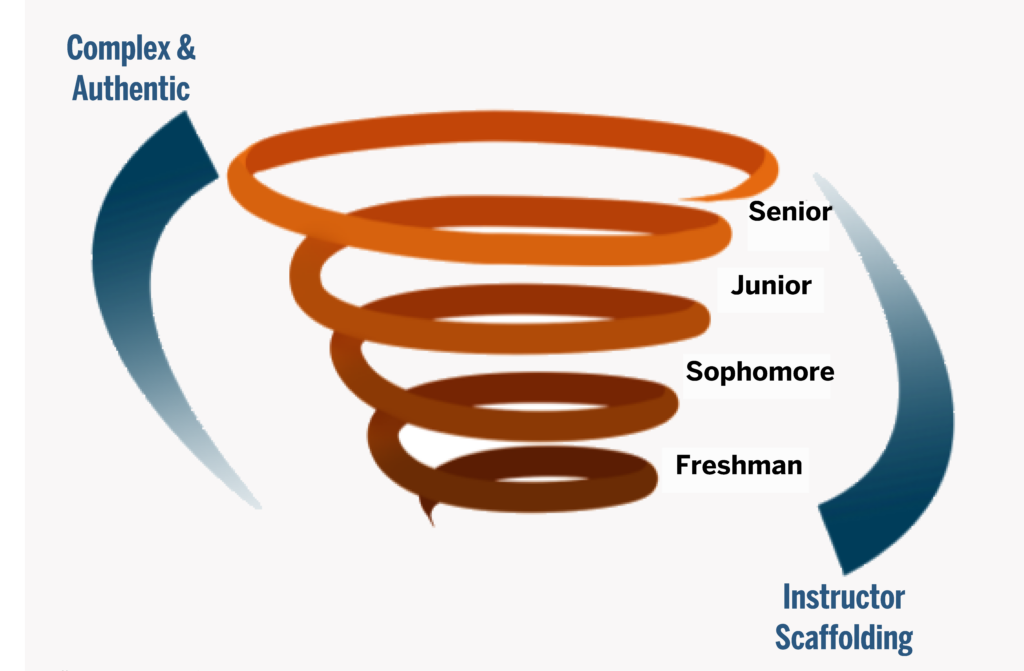
In early courses, students will receive a lot of scaffolding. They might be introduced to new skills, dispositions and/or character traits through examples, short reflections, structured discussions, guided activities, assignments using templates, or low-stakes assessments. Faculty may provide significant scaffolding by naming the skill or disposition, explaining why it matters, and helping students recognize what it looks like in practice.
As students move through the program, they encounter these same skills, dispositions and/or character traits in more complex technical contexts. For example, students may practice perseverance while debugging code, adaptability while responding to changing project requirements, empathy while designing for users, or communication while explaining technical decisions to a nontechnical audience. They may encounter them in internships or capstone courses, where they need to engage with using them relatively independently in authentic projects, similar to what they will do once they graduate.
A spiral curriculum helps faculty to:
- Introduce key character traits, dispositions, and cross-disciplinary skills early in the program.
- Reinforce these skills, dispositions, and character traits across multiple courses and learning experiences.
- Increase the complexity, authenticity, and professional relevance of learning tasks over time.
- Connect professional formation directly to disciplinary work, rather than treating it as separate from technical learning.
- Use behavioral indicators at increasing levels of complexity to observe, support, and assess student growth.
A spiral curriculum helps students to:
- Develop cross-disciplinary skills and professional dispositions gradually over time rather than in a single course or activity.
- Practice these skills and dispositions across different tasks, teams, tools, and disciplinary contexts.
- Transfer learning more effectively to real-world academic, workplace, and professional situations.
- Revisit important competencies at increasing levels of complexity as their technical knowledge grows.
- Build confidence, independence, and professional identity through repeated opportunities to apply, reflect on, and refine their behavior.
The goal is for students to move beyond simply understanding these qualities in theory. Through repeated practice, feedback, and reflection, students develop habits of thinking and action that prepare them to become technically capable, ethically grounded, and professionally ready graduates.